

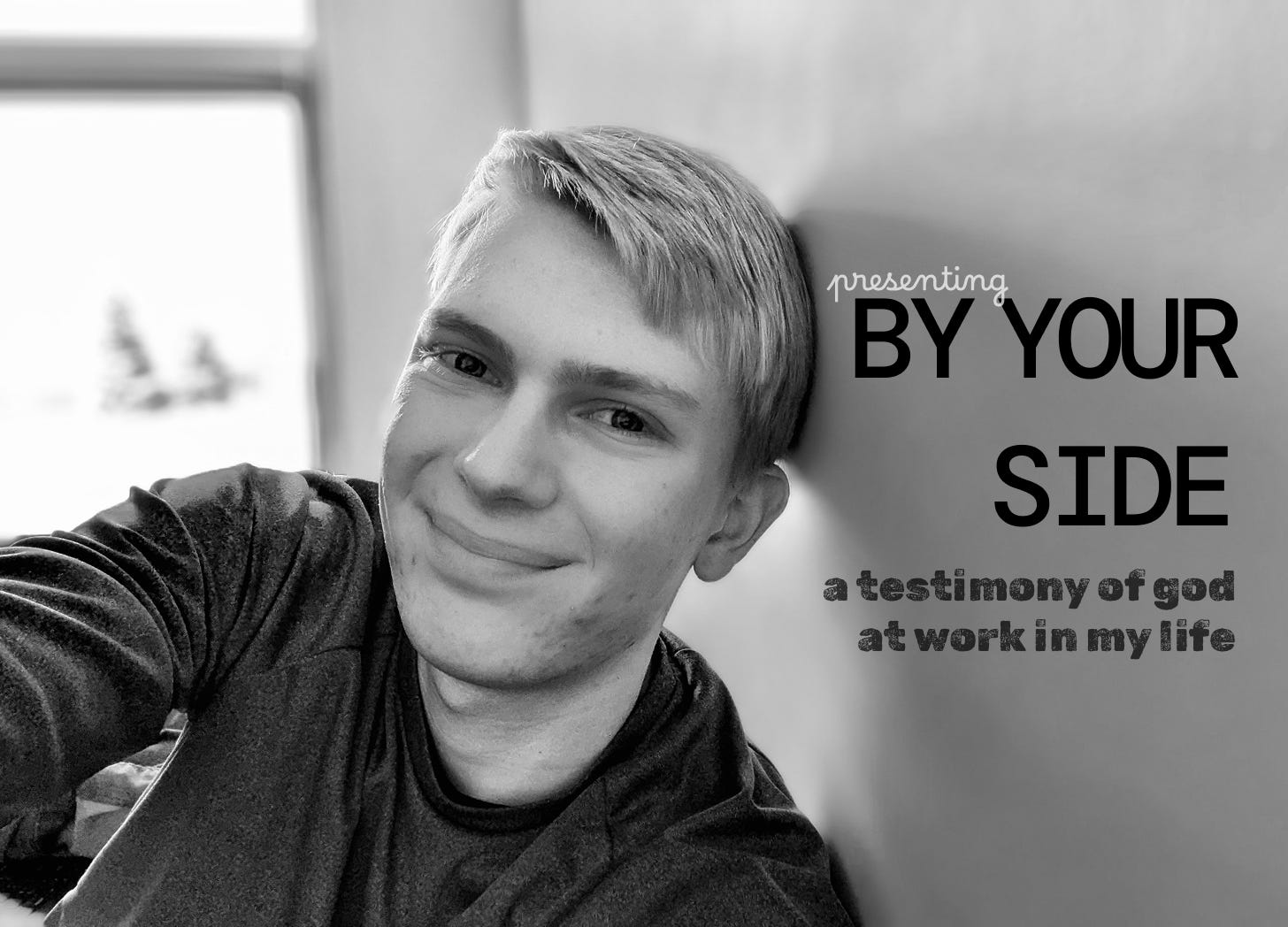
By Your side: A testimony of God at work in my life
Inspired by Forrest Frank's latest album CHILD OF GOD II - a testament of God working through every high and low in my life

Preface
It was shortly before midnight, a few weeks ago, on May 8th, when I was sitting alone in my dorm room with a mix of feelings. I was surrounded by the evidence of packing since I had just finished up my finals and concluded my sophomore year at Bethany Lutheran College. I was still getting over a cold that I had been suffering with for the past week, which had wreaked havoc on my last week. I hadn’t been to choir practice at all that week since I wasn’t able to sing and wasn’t going to be singing at graduation the following day, which was also when I had to move around my stuff to another room in the dorm before going home temporarily for my siblings’ confirmation and my birthday. In this moment, I was experiencing a mix of excitement, relief, fear, hope, and some pain from the multitude of different things spinning around my head, which was racing with thoughts that carried each of these feelings with them.
I was alone, since my roommate was with some other friends at an end-of-the-year party and was working on trying to pack up everything that I could and whatever items I wouldn’t need the next day. When I was taking a short break, I was nudged by Instagram about the release of Forrest Frank’s newest album, since he’s my favorite music artist and one of the few artists I follow on the platform. I resolved in that moment that I would listen to it right away since it was only 11 pm at that point, and I was surprised since I didn’t figure it would be released that early. Originally, I was expecting to have to wait until the next day to listen to it for the first time.
While I wasn’t probably the first person to stream the highly anticipated album, I was one of the first to get to hear it as soon as it came out, and played it out loud on my speakers that night in the midst of wrestling with thoughts and feelings of anticipation and uncertainty at the end of perhaps one of the most emotionally difficult semesters ever since the semester and a half that I spent online during COVID before becoming a homeschool student. I struggled with moments of isolation, wrestling and struggling in the dark with secret sins that still plague my life. I struggled with confusion and crisis about what I want to do with my life and where God wants me to be. I struggled with relationships as I had difficult conflicts with my friends and the people around me, some of which still remain unresolved and broken. Finally, I struggled with some theological conflicts with my overwhelmingly positive opinions about the very thing that Forrest has done so well and is so gifted with (i.e., contemporary Christian music), which many of my fellow Lutherans are so pessimistic about.
Yet, here, while I was listening and whenever I listen to Forrest, part of my soul felt lifted. The emptiness that I had felt throughout the whole semester felt alleviated, and I really became thoughtful about myself and what I stand for. Hearing Forrest’s testimony was so relevant, as someone who is a college student, finishing up their sophomore year feeling empty with the way their life has been going, and just feeling a burning inside their soul as they are struggling with none other than the question regarding purpose. I feel like I chase after so many unsatisfying things in my life, whether that be the endless scrolling that leaves me feeling helpless and purposeless as I destructively compare myself with others, or as I expect satisfaction from my sin and find myself even emptier after the fact. In all of the places that I have searched for meaning and purpose, the only place I have found it is in Christ and what He has done for me. The only time I am ever content is when I am doing something for His glory and not my own glory, such as what I’m writing right here, right now.
One of the things that the chaplain at my school told me during a discussion about an article I wrote about the lack of issue with contemporary worship is that my words as a writer have “the power to influence people.” He meant it as a warning to be careful with the way I talked about the issues that are near and dear to me, and I do come off a bit strong when it comes to this. However, it is my belief that we are all missionaries to people who are broken and in need of the Gospel, and it is my earnest prayer that God encourage me to always write and talk about Him. I have realized that I would rather talk about the Gospel and what I believe boldly, rather than speak subtly or with ambiguity. There should be no barriers to the Word of God, since the Gospel is for everyone. God wants all people to be saved and come to a knowledge of the truth (1 Timothy 2:4).
Recently, I had the opportunity to share about what I believe with a coworker who had very limited knowledge about what Christians believe. I pray that God works through me to lead others to Him through all that I do. I pray that whatever I say and do, that it would all be dedicated to Him and His glory and not mine. For this reason, I am writing the following testimony of my own faith about how God has shown such mercy and compassion to me that is heavily inspired by Forrest’s own testimony in his most recent album, CHILD OF GOD II.
The foundation of childhood
“Dedicate a child to the way he should go,
and even when he becomes old, he will not turn away from it.”
— Proverbs 22:6 (EHV)
I was fortunate to be raised in a Christian household, especially one where we openly talked about theological topics from a young age. Unfortunately, throughout this time, my church life was unsteady for much of my childhood. Our church attendance diminished when the denomination we were a part of began to drastically deviate from the teachings of the Gospel and God’s Word as a whole. The church where I met Jesus through the work of the Holy Spirit in my baptism as an infant and where my faith continued to grow and develop was beginning to fall to pieces, and in the midst of this, my family was floating away from regular sustenance in the blessings of worship. By the time I was around 10 years old, we would only occasionally go to church for holidays, and only actively attend Sunday school. Throughout this time of spiritual drought, my family was actively searching for a new home and considering whether we were willing to walk away from the church that my siblings and I had been baptized in, and my mom had also been baptized and raised in.
However, life kept moving and we were in that area of not having much for options being readily available. Not until I was a fourth grader, then things began to change. My dad is a farmer, and when I was a fourth grader, one couple who rented out their farm to him invited us to be involved in a club called Awana at the First Baptist Church in my hometown. The club was for children from Pre-K age up to 6th grade and was intended to help teach children about God through activities, lessons, and most of all, the memorization of selected verses from the Bible in workbooks that they had us complete. For the most part, I remember having fun, although there were plenty of different gimmicks about the program (including maybe being a bit too cult-like). It was during this time that I became a good friend of the youngest son of the pastor at the church.
Throughout this time, my faith and understanding of the world began to drastically change in mostly a negative way when I look back on it with retrospect. The theological foundation I had, however imperfect before, became more tinted by training that made me what I would call an unreasonably prideful Christian. I started to lose friends because I had become inoculated with a sort of pietistic pride that focused on what I was doing for God. I had gone from the childlike faith that modeled the tax collector and moved on to become more of a Pharisee. I had come to look down on other people who didn’t wear their faith on their sleeve or who didn’t seem to care about it.
I had wrongfully been trained to boil the message of the Gospel down to outward appearances and, in doing so, looked down on the people around me who didn’t pray, didn’t go to church, and didn’t know a bit of Scripture. The competitive nature of the club clashed with the Gospel. It was no longer a focus on what Christ had done for me, but it was all about my ability to remember passages from Scripture, or just my ability to know and fathom Him, and pridefully parade around about how I was active in my faith. Between this and my association with a friend who was similarly mannered, I started to lose friends and sank down in the popularity complex at public school. The further I stepped toward this manner of pride, the further I stepped away from what my faith should have been.
However, it was only a matter of time before something else came along and began to plague me. In the midst of my confusion, as a sixth grader, by combination of an accidental occurrence paired with ongoing sinful thoughts, I had begun to nurture the private sin that still plagues and scars me today — the sin that by the false definition of what I had been taught about repentance was one I hadn’t been turning away from as the temptation constantly lingered throughout my life and began to fully drown myself. Everywhere I turned and every way I tried to figure it, I felt ultimately damned. My once senseless pride turned into sensitive despair. I tried everything I could to overcome the temptation and will to sin out of my own doing, but it kept happening frequently. Yet, in the midst of this, my Lutheran background began to shine through again, especially after a family discussion that brought up a teaching that I opened this part of my testimony with, that is, Baptism’s sacramental nature.
At this point, my siblings and I had been faced with the tenets of decision theology (i.e. the notion that one must make a conscious decision to accept Christ) as is the norm in the Baptist church along with much of American protestantism and with it came the purely symbolic view of the Sacraments, especially including Baptism. During a discussion after Sunday school at our Lutheran congregation that we were still a part of for the time being, my younger siblings had a lesson about Baptism and how it brings salvation to those who are baptized (which is indeed a Scriptural and Biblical teaching as per 1 Peter 3:21). My younger sister, Mary, based on what she had been taught at Awana, made the claim that the Sunday school instructor was wrong and that we had been taught otherwise. My dad, however, was convinced otherwise of both the sacramental nature and importance of infant baptism, which cannot be found in most of protestantism at large, and countered that he was fairly certain that the Lutheran teaching was correct, which we would later be affirmed concerning this discussion.
Yet, as I struggled with the nature of my condition and the constant doubt concerning whether I had truly been saved or not since I could not point to a specific conscious decision that I had made to accept Christ into my life, I cried out to God in despair, “Fill me up and show me that I am saved. Lord, I do believe, help me overcome my unbelief. Help assure me that I am saved…”
Behind the scenes
“For I am convinced that neither death nor life,
neither angels nor rulers,
neither things present nor things to come, nor powerful forces,
neither height nor depth, nor anything else in creation,
will be able to separate us from the love of God in Christ Jesus our Lord.”
— Romans 8:38-39 (EHV)
In the midst of all of this behind-the-scenes turmoil, starting at around middle school, I had a 180-degree personality shift. I gave up on the pursuit of popularity and lost about all of my friends except my one friend from the Baptist church, Jacob. What replaced friends was more interest in learning, partly sparked through the rich apologetic and theological discussions at home and partly sparked through general curiosity and desire to get exceptional grades. I was one of the “smart kids” now, and I became more focused on being a better scholar.
After 6th grade, I graduated from the Awana program at the First Baptist Church, more confused than ever about my faith. At this time, I’m not sure exactly what I would have believed, except for much of a textbook sort of view of the Bible. I knew what it said, debated with my science teacher about the Biblical account of creation, and generally talked about it from a defensive, apologetic, and intellectual standpoint. I didn’t really understand the concept of doctrine proposed in Scripture since I had been confronted with two starkly different and opposing doctrines about salvation, and was living in between the Lutheran view and general protestant view, feeling that I just had always believed without attributing such faith to the doing of myself or God necessarily. My faith was just there, and I tried not to think about it.
In 7th grade, the former pastor of the Lutheran congregation we were loosely attached to retired, and a new, interim (i.e., temporary) pastor was called to lead the congregation for a short time. My dad, hearing that this pastor was much more conservative in his views concerning doctrine and social issues, became hopeful that the church could possibly make a change for the better, and so we started going to church again, and I started confirmation with this pastor. He was a nice enough guy and seemed to be more knowledgeable and attuned to the sort of Christian beliefs that we had begun to foster in our house, at least on the surface, anyway.
Confirmation with him wasn’t bad by any means, but my interest varied. Throughout the year on Wednesdays, members of the church, both my age and a year older than me, met in the fellowship area to hear the pastor go through lessons on Bible History. He normally prepared a summary of each of the books of the Bible that he read through, and we discussed and were able to ask questions. At the end of each time, he would give us a short quiz, and that was that. It wasn’t complicated, it was rather easy, and seemed to be interesting and insightful for the most part.
The sermons on Sunday mornings, however, were a completely different thing that changed in substance over time. The first few sounded generally okay and didn’t have any apparent problems. After all, it was from the biblical literalist point of view, and there was a little bit of Gospel in there somewhere. I honestly kind of wish I still had kept some of the required sermon notes that I had to take for confirmation, because I don’t remember these sermons all too well, so I’m unsure if the present me would have fully agreed with the content of the sermons. Regardless, the sermons progressively diminished in Scriptural grounding, to the point that the emphasis devolved to a pietistic view of salvation, with the emphasis returning to what “I” do for God and not what He has done for us. Looking back, I don’t think there was a bit of the Theology of the Cross to be found in His sermons, as they normally were moralistic lessons and takeaways from the teachings of Scripture, rather than clear Law and Gospel applications of the writings.
Eventually, my dad began to lose hope in turning the church around. In one conversation with the pastor, he asked about the possibility of the church joining a different denomination and leaving the church body that had fully abandoned Scripture. The answer, however, was an indirect, but solid “No.” My dad had the hope that the interim pastor would have been more willing to lead the church in a different direction, but the situation didn’t appear to allow for such. This, combined with some tension between him and the interim pastor that formed after a few events that rightfully upset my dad. Eventually, the sermons became so unfortunately poor and clearly lacking any substance of the Gospel that one Sunday, we just walked out and left. I’m not sure, but I don’t think we ever came back after that. So, once again, we became Christian vagabonds — out in the open, roaming without a church to serve as a religious roof over our heads.
However, for a long time, another thing was happening behind the scenes. God was still at work guiding us closer to a church we could actually call home. Previously, there had been one Sunday when I was late in getting ready to go to Sunday school and got left behind. I was a bit distraught, granted, but my dad decided to come back and pick me up after he had dropped my siblings off, and I rode with my dad in his red Ford pickup truck. My dad had formed a tradition throughout the time when we were unstable in our church life to go for a drive with the radio turned on while we were in Sunday school to catch the radio ministries of different nearby Lutheran churches. However, the one he specifically preferred was the shorter, 5-minute ministry of the smallest Lutheran church in our town. This ministry, which came on at around a few minutes before 10 o'clock, was called “The Voice of the Shepherd.” I remember driving throughout the countryside, sitting in the passenger seat, listening to the message of the pastor, and then talking about it with my dad before we went to pick up my siblings and go to the grocery store (another Sunday tradition). Little did we know that God was at work still through the message of this small church and that we would soon call this church our home.
A new direction
“But seek first the kingdom of God and his righteousness,
and all these things will be given to you as well.”
— Matthew 6:33 (EHV)
It was the middle of 2018 when things began to change again. My parents were convinced that we needed to find a more permanent church that we could call home. Since Lutheranism was familiar, we began looking into other Lutheran church bodies, both the church body of the small church whose radio ministry we had been listening to for so long, and its larger sister synod. We were considering the options: between larger but more distant churches in the Wisconsin Evangelical Lutheran Synod (WELS) or the closer, smaller church in the Evangelical Lutheran Synod (ELS). My dad and all of the family had looked at the belief statements of both church bodies, which were very similar and stood for everything that we were left clinging to regarding our faith.
Late that September, after praying for guidance and aid from God to help us find a church that taught what His Word teaches, my parents made the move and talked with the pastor of the small church that we came to call our home. That night, my parents decided that it was the church-home we had been praying for and resolved to join the church. The following Sunday was the first service we went to, in that small building located on a side street that branched off from the main street of my hometown. We had finally found a place where we could rest our souls and be spiritually nourished in the promises of the Gospel, all because of God’s gracious hand of guidance and His grace.
I still vividly remember that Sunday, and for the first time in a long time, I felt excited about being in God’s house. The sun was streaming brightly through the windows, lighting up the small sanctuary with brilliance. The bulletins, seeming to match the mood, had a picture of a bright sunrise and a Scripture quotation from one of the lessons on the front. The hymns were something new to discover, yet seemingly familiar, as if they echoed something that I had heard before, but only now started to recognize and grew to love to sing. The liturgy was richer than anything I ever remembered — we even sang the “Amen” at the end of every prayer in the hymnary. The sermon specifically talked about how we’ve disobeyed God’s Law, reminding us of our need for Christ, but more so included the Gospel and God’s grace and forgiveness. Little did I know, but this was the start of the overwhelming love that I would gain for the Gospel and for theology in general.
Shortly after we had become official members, I went through confirmation from the start again, but this time it meant so much more. It was different, and it was more intimate and focused on the truth. The pieces began to come together as my blurred vision of God’s Word focused on how it was all centered around Christ and what He has done for me, not what I could ever do for Him. I became inquisitive about God’s Word for once and began to explore it more than ever before. Looking back, I was so confused about what to believe and what not to believe, but now it all made sense. All of Scripture points to Christ, not to me. Abraham, Jacob, Moses, David, and all of the Old Testament believers were saved by faith in the same Messiah whose face was still veiled to them, but now has been revealed to us as the Son of God, Jesus Christ.
The very oasis that for so long my soul longed for was found in the Gospel message, that it wasn’t anything that I could ever do on my part, but it was all God searching out me and calling me to be His child solely because of His goodness. My sin no longer terrified me as much because I realized that my very concern, sorrow, and frustration over my sin was the very repentance that I thought I didn’t have. I felt the weight of condemnation lifted from my back because the gift of God is eternal life through Jesus Christ our Lord, not through my own filthy rags. There is no sin that was too great for God to forgive; in fact, Christ had already covered the sins of the whole world when He cried victoriously, “It is finished.” All sins are paid for, and the only thing that can prevent us from Him is the rejection of His forgiveness that He offers to all, freely of His own goodness.
I still would continue to struggle with some of the same sins that had plagued me for a long time, and I still struggle with those sinful instincts and temptations today, but thanks be to Christ for calling me back to Him over and over and over again through His Gospel message. Every time I come before His altar to receive His body and blood as spiritual sustenance, He renews His promise of forgiveness to me. He is the God whose mercies are new every morning. I was baptized, and that mark of promise was something that the devil could never take from me. Never, ever.
The continued struggle
Give thanks to the Lord, for he is good.
For his mercy endures forever.
— Psalm 136:1 (EHV)
In this life, the story is far from over, and the same goes for the battle against all our foes, our sinful flesh, the world, and the devil, who all seek to subvert our eyes from our benevolent God. It would be a lie for me to say that I haven’t often been despairing over the sins that plague me most in my life, the ones that the devil flaunts in front of me, trying to persuade me that I’m not good enough — that God can’t forgive these sins that seem to tower over me.
The worldly trio of foes have continued their assault without ceasing, knowing full well that the power of the Gospel lies marked and embedded deep into my heart. They will stop at nothing to try to get me to reject the promise or to give up in despair. Even as I continue to reckon with the way that my sinful tendencies seem to destroy me, I continue to run back to my Father, the God who calls me His child. There is nothing He can’t fix, and I try to assure myself with this promise each and every day of my life.
After I was confirmed, I didn’t stop diving deeper into what it meant to be a child of God. Each Sunday was an opportunity to further understand the height of God’s grace and the depth of His love. Even as I struggled with self-confidence, and began to become a nervous and social wreck at the turn of High School, I furthermore had a greater confidence: a God who looked down on me with favor because of the work of His only Son.
Yet this somewhat deep-down itching feeling couldn’t be ignored. Somehow, something within me was changing as I became more wary and tired of things in my life. The first darkest moment of this was during COVID when I was slowly segregated and made feel different because of personal feelings and beliefs. Surely, the world no longer looked on me with favor, and I felt suddenly treated differently, becoming the spotlight of emotional and psychological abuse from fellow students and teachers. It hurt each time I was made to feel like I was wrong about God, as my Biology teacher continued to throw obstacles to my faith, whether intended or not, but knowing full well of my religious background. It hurt when I was laughed at because I was different: I went to a church that nobody knew about, I didn’t have social media, wasn’t popular, and slowly, just felt like the one loner weirdo who was either ignored or heaped insults on.
My opinions became irrelevant and sank in quiet lamentation as I resorted to asking God why I felt like I was so messed up. My sin started weighing on me deep inside as I felt disconnected from what I believed and how I felt like I was living. I started to blame my state of misfavor and awkwardness in the world on myself, and as my own fault. It was the punishment for the twisted corners of my heart, or at least it felt that way. I started losing my innocence and sank deeper and deeper. I still talked about God, I still believed in Him, I still felt forgiven, but part of me still blamed myself, and part of me still felt in doubt. I desperately begged and pleaded for this thorn in my flesh to depart.
My parents pulled us from public school after my sophomore year of high school. I had spent most of my sophomore year at home anyway because of the pandemic, while the rest of my classmates were still in person at school. I had gotten over being around friends, and honestly didn’t care as much anymore. The few friends I still had got shifted to the wayside, and I avoided eye contact with my former classmates whenever I ran errands in town or went to the grocery store. Part of the odd feeling still lingered, and I still felt shunned. I was just the silent kid who didn’t say much, who had strange habits and didn’t fit in since I didn’t like the things everyone else liked.
There was the lingering feeling of being an outcast that had started to set in since I was in middle school, and even before that. I got singled out for enjoying school and learning. I got singled out for being smart. I got singled out for talking about my faith and being passionate about it. I got singled out for the music I listened to (since I have long listened to almost exclusively contemporary Christian music). I got singled out in Physical Education and was made to feel subconscious about the clothing I was wearing: my shorts were “too short,” and the clothing I wore was evidently unacceptable. Like, who thought it was appropriate for guys to change in front of each other at the start of adolescence and at an extremely vulnerable point in life? I was forced into a fixed standard, but was too stubborn to blend in, all of which came at the expense of my social intelligence. I became that awkward kid, and while I didn’t see a problem with being different, evidently, I became everyone else’s problem.
Homeschool gave me an escape from that. It gave me a chance to start healing and to be closer to God than ever. Home was where we prayed before meals. Home was where we talked about God. Home, although imperfect, was where we loved each other. Home was the place I wished I had been all along, to be nurtured and not degraded and despised. It was a place to escape the trauma of always feeling judged by everyone and a place to be with siblings and to live through all of the natural, funny, intimate familial moments with a feeling of joy. For once, I felt at least somewhat more normal, and I was where I couldn’t think of any better place to be. It was a necessary chapter and break from the pain. While I still struggled from time to time, I was granted a chance to heal and break free from the demands of the world. God worked through this time to make me a better me and to work at healing my scars.
Finding sufficiency
“I was given a thorn in my flesh,
a messenger of Satan, to torment me, so that I would not become arrogant.
Three times I pleaded with the Lord about this,
that he would take it away from me.
And he said to me, “My grace is sufficient for you,
because my power is made perfect in weakness.”
Therefore I will be glad to boast all the more in my weaknesses,
so that the power of Christ may shelter me.
— 2 Corinthians 12:7-9 (EHV)
In 2023, I graduated from high school as a homeschool student through a non-denominational online institution called Ignite Christian Academy. I was finally finished with the first educational chapter of my life, and now had butterflies in my stomach. College was the next step, and I had already figured out where I was going, got the highest scholarship I could, and it was the one and only school I applied to. In part I was excited. However, mostly I was afraid. I was worried:
“Will people like me?”
“Will I fit in?”
“Will I do well?”
“Will I become homesick?”
“Will I survive?”
When I started out during my freshman year at Bethany, I was so fortunate to have a good roommate who I would say is the best friend that I’ve formed during my time here so far. My roommate, Erik, was someone whom I was extremely fortunate to meet since we both came in knowing practically nobody at the school. We were taking Calculus together, with me originally being a Chemistry major and him being an Engineering major. We spent the first couple of months spending pretty much all of our time together. I honestly really didn’t start forming friends right away either, since I was afraid of the questions above, and I had a best friend for a roommate already.
I loved Bethany right away, and despite having other things in the background that were terrifying me, I did quite well during my Freshman year. I finished up with a 4.0 (that I immediately lost the very next semester), and I fortunately started to branch out. However, practically being the first of my siblings to attend college, things like the greater area of Mankato, commuting, and getting a job off-campus terrified me. I tried, but ended up empty-handed and blamed myself because my outcast nature and social awkwardness were still overwhelming me. To describe the lengths I went to socially protect myself, I took my gen ed speech class online. I knew my limits, and I didn’t want to kill the vibes.
I didn’t know everyone, and immediately, there were certain people whom I unnecessarily avoided because I was afraid of ruining it again. Thankfully, college doesn’t have as much of a popularity complex as high school, and soon, I was able to come out of that shell more and more. I still get a bit flustered in the face when meeting new people, and I still don’t even know many of the students who go to my small school. The irony behind it all is that, with all of this, I had a journalism scholarship since I wrote for school newspapers and magazines and did yearbook stuff in high school. It required that I write for the college’s student newspaper, which meant interviewing random students I didn’t know, and perhaps was the most awkward thing of my freshman year—and I was the interviewer, not the interviewee—I should have been the confident one. I mean, but, hey, I finally got a smartphone to feel more on par, like that was the solution to being antisocial (although it did become a sort of confidence boost).
Yet behind all of this was the sinful secret that I feel is akin to Paul’s thorn in the flesh. At this point in time, it didn’t feel as uncontrollable or prevalent as before, but it was still lurking beneath with all of its poison and menace.
When my sophomore school year came around, I was more focused on certain things that I had previously let slide. I worked a gimmicky side gig in AI training, along with being involved in the activities committee at Bethany, as I had been since the previous year. Then, when the side gig ran dry, I started working with elementary students lagging behind on their literacy skills after previously working with neurodivergent students regarding math skills (which I continued to do). I also tutored fellow students and realized how much I enjoy teaching, even if I was kind of winging it sometimes. With this, however, came a crushing reality—I started to feel extremely isolated and detached from my friends, who were free whenever I was busy and busy whenever I was free.
The ugly thorn in my flesh began to bear its face again with more severity and worsened to the point that I was forced to confront it to try to drown it again, but no matter what, the sin that I have prayed for God to take away for so long and convinced myself if only I was strong enough, then I would be able to overcome it continues to confront me daily—and sometimes, I fail and fall for the temptation.
In the midst of some of the other hard things this semester, such as learning struggles in certain classes, sleeplessness, restlessness, anxiety attacks, friend group problems, overall isolation, a feeling of loneliness, and, some days, a lack of will to live, I began to realize something. I began to note when and where my temptations would leave me alone: when I was with others, when I wasn’t stressed, when I was somewhere close to God such as chapel or choir, when I was surrounded by what would encourage me with the Gospel message, when I was listening to music that repeated promises of the Gospel, and when I was singing hymns, psalms, and spiritual songs throughout all of this.
Toward the end of the semester, I started going on walks with my earbuds in listening to my main CCM playlist and my eyes wandering to focus on the world around me: the grass beneath me, the trees around me, the clouds passing by in the sky, the sun shining brightly as it sunk behind Bethany’s Trinity Chapel and flooded the sky with radiant light, yet the music is what made it magical. And that’s the thing: music is so powerful. It can influence our mood and make us feel joy. It can provide our bodies with healing. When we sing, it can be the way that we can release our sorrows and let God be praised and hallowed for what He has done. Music is probably the most impactful form of worship—the way to not only praise, but to pray, to teach, to comfort, and to ensure that God’s name is hallowed among us.
Also, at the end of the semester, I felt some shifting priorities and shifting views on things I once didn’t feel so strongly about. First of all, I had a bit of a mid-college crisis and asked if I was really doing what God wanted me to do with my life. My resolve, however poorly executed thus far, was to write more and do more to be closer to God and to spend more time with His Word, because that’s where I felt best equipped to ward off temptations that had come my way.
I’m so fortunate that a college like Bethany exists in the first place, and I pray that the school continues to exist for years to come. Yet, at the same time, I also started to recognize the problematic treatment of contemporary music in my church body. While I wouldn’t trade the Christ-centered views of Scripture for anything, it’s upsetting for me when so few of our youth are staying in the church, even as my generation has caused a sort of comeback in church attendance. Our outreach is poor to those who need the Gospel, and many Lutheran bodies are living in the past instead of moving forward. There is a need for work to be done, and so I wrote a somewhat fiery opinion article for our student newspaper that really begged the questions, “What is wrong with this, in any way, shape, or form?” and “Why are we shunning our churches that have, in good faith, resolved to introduce it into their worship?”
I know that there are so many people in my generation who feel so lost right now. I know that there are so many people who need the Gospel just like I do, who are suffering because they have been convinced that what the world has to offer is what will give them satisfaction. Yet, from me to the world, I can tell you that this can’t be more false. Jesus is the only source of hope in this dark, dismal world. Jesus is the only thing that can give you satisfaction. Jesus is the only thing that can make you whole. The more opportunities we provide people with to encounter the Gospel, the more likely that God will begin to work in their hearts. In fact, an interesting thing that I came across earlier today proposed the fact that when we keep rolling the dice, when we keep taking the chance that something will work out, the more likely and more probable it is to work. This is no different with the Gospel. The more we keep putting it out there, the more likely it is to take root. We can never be too mission-focused, and we are all missionaries to the world.
My life has been messy and imperfect. I’ve tried and failed in the face of temptation. I’ve sinned and done wrong. I’m not always the person I’d like to be, who I’d like to wake up to and see in the mirror, but despite all my flaws, my imperfections, my struggles, His grace is sufficient to cover all that. His grace is sufficient to give me strength as I bear my crosses. His grace is sufficient to provide me with all I need. My sufficiency is found in His grace and His forgiveness alone. Jesus is the only way and the only source of satisfaction that we will ever find in this world of sin, sorrow, grief, and shame. So no matter the effort, no matter the cost, no matter what - it is our joy and privilege to be the sower who gets to spread the seed of the Gospel to the hearts of mankind. This is what is most crucial in our lives, and this is my testimony of how God has been by my side through it all, the highs, lows, and in-betweens. My encouragement to those reading is to let God use your brokenness to bring about healing in both your life and the lives of others. We are all sinners who have fallen short of God’s glory, but we have all been made righteous through his blood. Let us never forget this fact. Amen.
Final thoughts
If you are searching for the freedom that only God can give, don’t wait! His Word has the power to make you whole again. His all-powerful, creative Word has the power to create faith in the hearts of mankind. God’s grace is an eternal, overflowing fountain of life — for the God who desires mercy, not sacrifice, there is no sin too great to be forgiven.
Many of the verses I used throughout my testimony are very near and dear to me, however, nothing compares to Matthew 6:33, the verse that my pastor chose as my confirmation verse. I will never forget its message to not worry about the things of this world, but to seek God first, and He will provide the rest with time.
As I mentioned previously, Forrest Frank and his music and testimony all heavily inspired the writing of this, my testimony and account of my journey with God through the days gone by. If you are curious about Forrest and his music, you can find more on his website: forrestfrank.com.
If you want to read more Gospel-centered pieces from me, keep exploring this Substack. Some of my favorite pieces I’ve written recently are below:


To find out more about what I stand for, check out my manifesto at manifesto.heyjames.space. Thank you for reading and supporting my work.